Memory Layout: Stack vs Heap
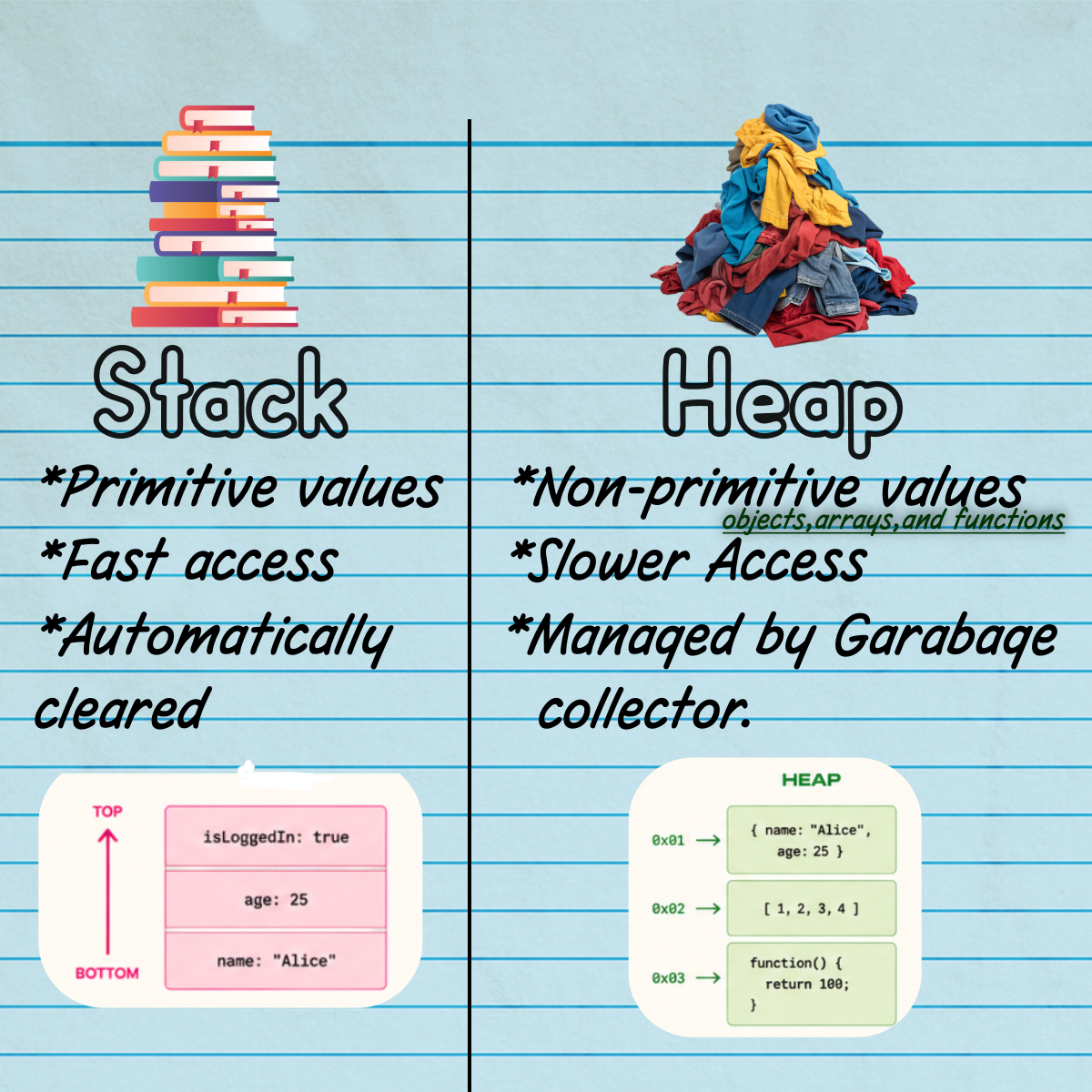
JavaScript manages memory allocation automatically, split between two primary memory architectures: the Stack and the Heap.
1. The Call Stack (Primitives & Pointers)
The Stack is a high-speed LIFO (Last In, First Out) structure. It holds static data whose size is known at compile time:
- Primitive Values:
number,string,boolean,null,undefined,symbol,bigint. - Memory Pointers: 64-bit reference addresses pointing to dynamic objects in the Heap.
2. The Heap (Dynamic Allocation)
The Heap is an unorganized memory pool storing complex, dynamic data structures:
- Objects, Arrays, and Functions are stored on the Heap.
- Copying an object variable (e.g.,
let b = a) only copies the Stack pointer, so both variables reference the exact same memory allocation on the Heap!
3. Critical Takeaways: Shallow vs Deep Copy
Methods like Object.assign() or the spread operator {...obj} only perform a shallow copy. Top-level primitives are duplicated, but nested objects still share memory addresses on the Heap. True deep cloning requires recursively creating new Heap allocations for all nested structures.
The Challenge: Deep Memory Cloning
Implement a function deepClone(obj) that recursively clones an input object (including nested objects and arrays) so that no Heap object references are shared between the original and the clone.